


The Hackesche Höfe in Berlin: History, Architecture and Tips
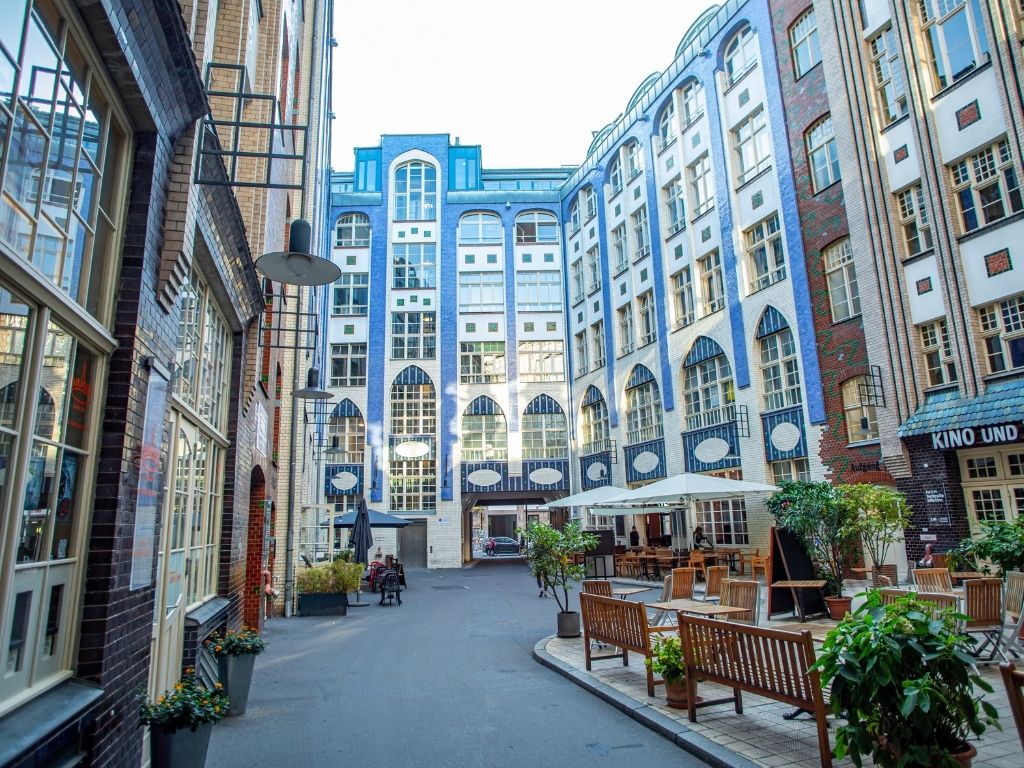
The Hackesche Höfe are a listed complex of eight interconnected courtyards in Berlin-Mitte. Since opening in 1906, they have combined homes and workspaces with shops, restaurants and cultural venues. They are particularly well known for the Art Nouveau façades in the first courtyard, designed by August Endell.
Visitors can admire the historic architecture, browse a variety of shops or combine a walk through the courtyards with a visit to a café, cinema or theatre.
What are the Hackesche Höfe?
The eight courtyards extend between Rosenthaler Straße and Sophienstraße, not far from Hackescher Markt. Several passageways connect the individual areas.
The way each courtyard is used varies. Alongside homes and offices, there are shops, workshops, restaurants and cultural venues. This means that the Hackesche Höfe can be experienced both as an architectural attraction and as an urban quarter that remains in active use.
On a first visit, it is worth seeing more than just the well-known first courtyard. Only by continuing through the other passageways can visitors gain an impression of the complex’s layout and its different uses.
Art Nouveau Architecture in the First Courtyard
The first courtyard is the most architecturally striking part of the complex. Its colourful façades, ornamental forms and individually designed windows differ markedly from many traditional Berlin commercial courtyards.
Kurt Berndt Designed the Courtyard Complex
The Hackesche Höfe were built according to the plans of architect and building contractor Kurt Berndt. He designed and constructed the entire complex, including its residential, commercial and event spaces.
August Endell Designed the Art Nouveau Façades
August Endell was responsible for the façades in the first courtyard as well as the design of the former function rooms and other interiors. Their defining features include coloured facing bricks, flowing forms and numerous individually designed windows.
When walking through the courtyards, it is therefore worth looking up at the higher sections of the façades. Interesting details are not limited to eye level.
Features to look out for in the first courtyard:
- colourful façade surfaces and facing bricks
- flowing lines and ornamental forms
- individually designed windows
- the passageways between the courtyards
- the combination of historic architecture and contemporary use
What Can You Do at the Hackesche Höfe?
The courtyards appeal to a variety of interests. Some visitors come primarily for the architecture, while others combine their walk with shopping, dining or a cultural activity.
Walk Through All Eight Courtyards
A walk can begin at the entrance on Rosenthaler Straße. From there, passageways lead into the other courtyards, with busier areas alternating with quieter residential and working spaces.
As people also live and work in the courtyards, visitors should respect private entrances and be considerate of residents and employees when taking photographs.
Discover Shops and Craftsmanship
The courtyards contain shops specialising in fashion, design, arts and crafts, and speciality products. Examples of businesses with a strong craft focus include Golem Baukeramik in the sixth courtyard and Coy Hutsalon in the eighth courtyard.
As tenants and retail concepts may change, it is advisable to check the current shop directory before making a specific shopping trip.
Cinema, Theatre and Other Cultural Venues
The cultural venues currently located within the complex include the Chamäleon Theater and the Hackesche Höfe Kino in the first courtyard, as well as Billardsalon Köh in the sixth courtyard.
Anyone planning to see a film or performance should check the programme, ticket prices and admission requirements directly with the respective venue.
Cafés and Restaurants
Food and drink venues are also part of the courtyards’ current use. Current listings include Röststätte and Restaurant Oxymoron in the first courtyard. There are also other cafés, restaurants and speciality shops.
Opening hours vary between businesses. Anyone planning to visit a particular restaurant or café should therefore check the information provided by the individual operator.
The History of the Hackesche Höfe
The history of the Hackesche Höfe spans Berlin’s urban expansion at the beginning of the 20th century, the Nazi era and the GDR period, through to the extensive restoration following German reunification.
Opening in 1906
The courtyards opened in 1906. From the outset, they combined homes, commercial premises, retail spaces and event venues. The former function rooms, clubs and Kino Imperial also made the complex a cultural meeting place. The courtyards were also part of Jewish life in the Spandauer Vorstadt district.
Expropriation and Wartime Damage
During the Nazi era, the Hackesche Höfe were sold at compulsory auction. The owner at the time, Jakob Michael, had already emigrated from Germany. In the final days of the Second World War, the first courtyard was badly damaged by bombs.
The Courtyards During the GDR Era
In the GDR, the complex became state-owned property. Tenants initially prevented the Art Nouveau façades in the first courtyard from being removed. Parts of the street-facing façade were altered later. Today, the complex is protected as a listed monument.
Restoration After German Reunification
Following German reunification, the Hackesche Höfe were revitalised and extensively restored during the 1990s. Historic elements were restored and spaces were created for contemporary use. Today’s concept once again combines living, working, culture, dining and retail.
Who Should Visit?
Interest | Particularly Relevant | Planning Tip |
|---|---|---|
Architecture | Art Nouveau façades in the first courtyard and the passageways between the courtyards | Remember to look at the upper sections of the façades |
Berlin History | Development, expropriation, wartime damage, the GDR era and restoration | Combine the visit with nearby historic sites |
Culture | Theatre, cinema and billiards hall | Check the current programme separately |
Shopping | Design, fashion, crafts and speciality shops | Check the tenant directory in advance |
Food and Drink | Cafés and restaurants in several areas | Check the details provided by the chosen venue |
Photography | Façades, passageways and changing perspectives | Respect residents’ privacy |
Those primarily interested in architecture can explore the courtyards as part of a walk. More time should be allowed for a visit to the cinema, theatre or a restaurant.
Getting to the Hackesche Höfe
The official entrances are located at Rosenthaler Straße 40 and Sophienstraße 6 in Berlin-Mitte.
By Public Transport
Nearby public transport stops include:
- Hackescher Markt S-Bahn station
- Weinmeisterstraße U-Bahn station
- tram stops around Hackescher Markt
Current connections and possible service disruptions can be checked using the BVG journey planner for details.
The Hackesche Höfe do not have their own parking facilities. Given the limited availability of parking in Berlin-Mitte, travelling by public transport is recommended.
Are the Hackesche Höfe Accessible?
The operator describes the routes through the courtyards as accessible. However, some shops and cultural venues may only be accessible via steps.
Anyone wishing to visit a particular business or venue should therefore check its accessibility in advance on the relevant website or by telephone.
A Memorial Site in the Neighbourhood
Immediately nearby is the Museum Blindenwerkstatt Otto Weidt. The museum is located at Rosenthaler Straße 39 in the neighbouring Haus Schwarzenberg and is not part of the Hackesche Höfe.
The exhibition tells the story of small factory owner Otto Weidt. During the Second World War, he employed mainly blind and deaf Jewish people in his broom and brush workshop. He tried to protect his employees from persecution and deportation and hid some of them in the workshop.
A visit to the museum should be regarded as a separate engagement with history in its own right.
From Classik Hotel Alexander Plaza to the Hackesche Höfe
From the Classik Hotel Alexander Plaza on Rosenstraße, it is around a five-minute walk to the Hackesche Höfe. The route leads through Berlin-Mitte towards Hackescher Markt and Rosenthaler Straße.
The boutique hotel is housed in a listed building near Hackescher Markt and Museum Island. The Berlin Cathedral, the Humboldt Forum and Alexanderplatz are also located near the hotel.
A possible route focusing on architecture and history:
- Start at Classik Hotel Alexander Plaza
- Walk to Hackescher Markt
- Walk through the eight Hackesche Höfe courtyards
- Visit the neighbouring Haus Schwarzenberg
- Continue towards Museum Island
This route links several destinations in Berlin-Mitte without making the hotel the main focus of the article.
Conclusion: Combining Architecture, History and Berlin’s Urban Culture
The Hackesche Höfe bring together historic architecture, urban history and contemporary Berlin culture within a compact area. A walk through the courtyards is particularly interesting for visitors wishing to combine Art Nouveau façades, smaller shops, dining and cultural venues.
From the Classik Hotel Alexander Plaza the courtyards are around a five-minute walk away. This makes it easy to combine a visit with Hackescher Markt, Haus Schwarzenberg and a walk towards Museum Island. Anyone planning to visit a particular cinema, theatre, restaurant or shop should check the venue’s current information in advance.
Frequently Asked Questions About the Hackesche Höfe
What are the Hackesche Höfe?
The Hackesche Höfe are a listed complex of eight interconnected courtyards in Berlin-Mitte. They combine homes and offices with shops, restaurants and cultural venues.
How Many Courtyards Are Part of the Complex?
The complex consists of eight interconnected courtyards.
Who Designed the Hackesche Höfe?
The complex was built according to the plans of architect and building contractor Kurt Berndt. August Endell was responsible in particular for the Art Nouveau façades of the first courtyard, as well as several interiors and the former function rooms.
What Can You Do at the Hackesche Höfe?
Visitors can admire the architecture, walk through all eight courtyards, discover shops and craft businesses, or visit a café, restaurant, cinema or theatre.
How Do You Get to the Hackesche Höfe?
One entrance is located at Rosenthaler Straße 40 and another at Sophienstraße 6. Nearby stations include Hackescher Markt S-Bahn station and Weinmeisterstraße U-Bahn station.
Are the Hackesche Höfe Accessible?
The routes through the courtyards are described as accessible. However, individual shops and cultural venues may have steps or other restrictions.
How Far Are the Hackesche Höfe from Classik Hotel Alexander Plaza?
The Hackesche Höfe are around a five-minute walk from Classik Hotel Alexander Plaza.
Is the Otto Weidt Workshop for the Blind Part of the Hackesche Höfe?
No. The Museum Blindenwerkstatt Otto Weidt is located at Rosenthaler Straße 39 in the neighbouring Haus Schwarzenberg. It is an independent memorial site.