


The History of the Classik Hotel Alexander Plaza – Tradition Meets Modern Berlin
The Classik Hotel Alexander Plaza is located in the historic heart of Berlin, in the traditional Marienviertel district. This stylish boutique hotel on Rosenstraße has an eventful history and combines Berlin heritage, architectural charm and modern comfort in a unique way.
A Hotel in the Oldest Part of Berlin
The Classik Hotel Alexander Plaza is situated in one of Berlin’s oldest urban areas. As early as the 13th century, an important urban centre developed here around St Mary’s Church. Today’s Rosenstraße is one of the oldest streets in the capital and has connected history, culture and urban life for centuries.
The area surrounding the hotel tells the story of medieval Berlin, historic trade routes and the city’s development into a modern metropolis. Today, guests benefit from the central location near Alexanderplatz, Museum Island, Berlin Cathedral and Hackescher Markt.
A Historic Building with a Distinctive Character
The building that houses the hotel today was constructed around 1900 as a prestigious commercial complex. It originally accommodated an international fur trading business and later well-known companies from Germany’s watchmaking and electrical industries. The building partially survived the Second World War and is therefore one of the few historic structures in this district to have endured the war.
Following extensive renovation, the building was converted into an elegant hotel in the 1990s. Since then, the Classik Hotel Alexander Plaza in Berlin-Mitte has combined historic architecture with modern design and high-quality hospitality.
Rosenstraße – A Place in Berlin’s History
Rosenstraße is of exceptional historical significance to Berlin. Over the centuries, the street developed from a small medieval lane into an important route through the centre of the capital. Its historic buildings and proximity to major sights make the hotel’s location particularly appealing to city-break visitors, culture enthusiasts and business travellers.
Detailed information about Rosenstraße can be found here →
Heidereutergasse and Jewish Life in Berlin
The historic Heidereutergasse is located directly beside the hotel. Berlin’s first synagogue stood here at the beginning of the 18th century, making it an important site of Jewish history in Germany. Today, the Alte Synagoge Berlin memorial commemorates this significant part of Berlin’s cultural history.
The Classik Hotel Alexander Plaza therefore stands in a location that connects Berlin’s past and present in a distinctive way.
Detailed information about Heidereutergasse can be found here →
A Stylish Boutique Hotel in Berlin-Mitte
Today, the Classik Hotel Alexander Plaza offers stylish accommodation in the heart of the capital. Guests can enjoy:
- elegant rooms & suites
- modern design with historic charm
- a central location in Berlin-Mitte
- short distances to Alexanderplatz and Museum Island
- exclusive meeting and business spaces
- high-quality cuisine and personal hospitality
The hotel is ideal for city breaks in Berlin, business trips, meetings, weekend stays and cultural holidays.
Rosenstraße
Rosenstraße is located in one of Berlin’s oldest urban areas: the Marienviertel district.
Current research assumes that the settlement of Cölln was founded around 1180, Berlin with St Nicholas’ Church and Molkenmarkt around 1200, and another urban area, in which St Mary’s Church was built during the second half of the 13th century, around 1220. The palace district in the northern part of Spree Island did not emerge until much later, in the middle of the 15th century.
The Classik Hotel Alexander Plaza is located at Rosenstraße 1. Rosenstraße is one of Berlin’s oldest streets. Until the 17th century, it was known as “Hurengasse”. This name appears in the death register of St Mary’s Church in 1583 and in the same church’s marriage register in 1624. During the 17th century, the lane was renamed “Rosenstraße”. Whether this name sounded any more respectable to people at the time remains open to question. At that time, lanes or streets known as Rosengasse or Rosenstraße were often named ironically because they were notorious for their uncleanliness or the poor reputation of their residents.
Rosenstraße was paved during the construction of the fortifications in the 17th century and was provided with a well.
Until the end of the 19th century, the buildings along Rosenstraße were highly inconsistent. The houses had one, two or sometimes three storeys, with some converted attic spaces. In 1894, the entire eastern row of 31 buildings was demolished. A comparatively prestigious four-storey development was constructed on this side in 1895 and 1896. The architects were H. Kayser and Otto March, the father of Terner March, who built Berlin’s Olympic Stadium for the 1936 Olympic Games. The development on the opposite side remained inconsistent and included, among other buildings, a house dating from 1760.
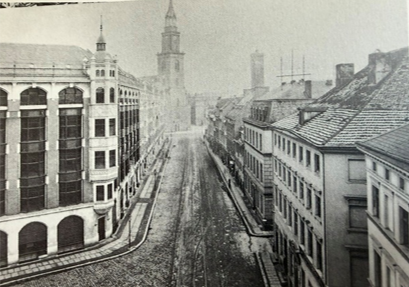
This is how Rosenstraße looked at the end of the previous century. The street had been widened from 13 to 20 metres, increasing its importance as a main thoroughfare between north-eastern Berlin and the Old Town.
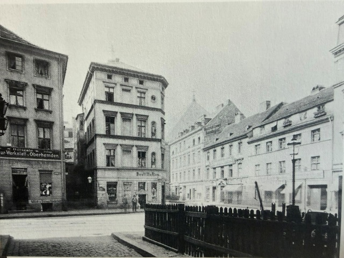
This image shows, around the turn of the century, the building that now forms the architectural core of the Classik Hotel Alexander Plaza. It depicts the corner of Rosenstraße and what is now Luisa-Karch-Straße.
Old Berlin was systematically bombed in the spring of 1945. A landscape of ruins remained, together with a number of buildings that were undamaged or only slightly damaged. These included the building that now houses the hotel at Rosenstraße 1. After the Second World War, the urban planners in East Berlin deliberately sought to create a central area in this part of the city – in a sense, a centre of the GDR. The concept of large open spaces bordered by multi-storey buildings apparently played a defining role. Alexanderplatz was partly designed according to this principle, as was the area between the River Spree and Alexanderplatz station, with today’s monumental television and observation tower.
At that point, the planners’ urban-design imagination apparently came to an end. The area in which the Classik Hotel Alexander Plaza is located today illustrates this clearly: a collection of parking areas and playgrounds that were only partly used because of their location, together with a high-rise building. Rosenstraße became a back courtyard – the back courtyard of the eleven-storey building complex on Spandauer Straße and Karl-Liebknet-Straße. To make this complex possible, two buildings from the surviving row on the eastern side of Rosenstraße were even demolished.
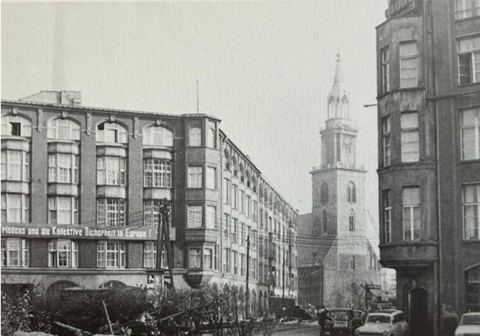
A view along Rosenstraße from around 1960: the Classik Hotel Alexander Plaza is on the right, opposite the building now occupied by the Instituto Cervantes. St Mary’s Church, built in the Gothic style, can be seen in the background
Heidereutergasse
Today, Heidereutergasse runs alongside the small park that houses the Old Synagogue Berlin Mitte memorial and leads to the hotel’s underground parking garage.
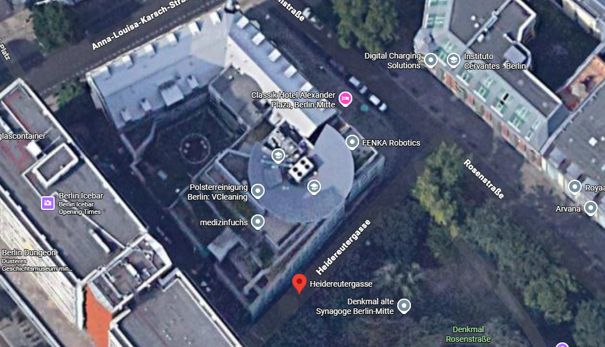
The lane was to acquire great significance for Jewish life in Berlin. It was once a small lane between the present hotel building and the neighbouring building. At the beginning of the 18th century, the city’s “Jewish community” purchased a plot on Heidereutergasse on which Berlin’s first synagogue was built. The Jewish population living in Berlin at the time – around 120 families comprising just under 600 people – lived mainly a few hundred metres south of this site, in the “Jüdengasse”, near the former “Judenhof”. Construction of the synagogue was approved on the condition that the building could not be taller than a single-storey town house belonging to a Christian. The synagogue was therefore built below the surrounding street level. Worshippers had to descend to enter the building. The synagogue was inaugurated in 1714 in the presence of the royal family. The plain, unadorned rectangular hall resembled the simple church buildings of the period, the best known of which was the Garrison Church. In the 1850s, Eduard Knoblauch redesigned both the exterior and interior of the synagogue.
Neither the synagogue on Heidereutergasse nor the surrounding buildings used by the community administration were destroyed or damaged during the pogrom night of 9 to 10 November 1938. This was presumably because the buildings had already been expropriated. The Deutsche Reichspost became the owner. The final Jewish services were held from 13 to 20 November 1942. By that time, deportations from Berlin had already been taking place for more than a year.
The synagogue and the neighbouring buildings were probably not destroyed by air raids until February 1945. Today, the Classik Business Space stands beside the hotel where Heidereutergasse originally began.
The History of the Classik Hotel Alexander Plaza Building
The building at Rosenstraße 1, now home to the Classik Hotel Alexander Plaza, has experienced an eventful history. If stones could talk, they would tell not only of the historical events that unfolded directly outside the building, but also reveal stories from its “inner life”.
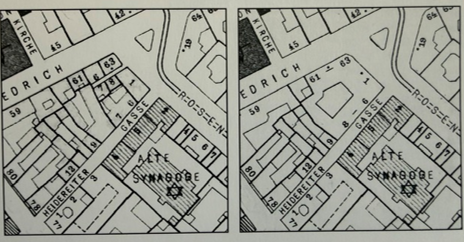
Several small buildings originally stood on the site where the commercial building was later constructed. On 4 April 1898, fur trader Siegfried Abrahamsohn acquired them on the basis of a “conveyance order issued by the Royal Local Court”. The buildings were demolished shortly afterwards, and the commercial complex at Rosenstraße 1 was constructed and completed in 1900.
City map: the original development is shown on the left and the new commercial development on the right; notably, the narrow lane by number 63 was lost to the new building
After the building was completed, Abrahamsohn’s fur trading business and an electrical goods dealer occupied the generously proportioned premises. Furs from all over the world passed through the building on their way to wardrobes and homes.
On 1 January 1933, ALPINA of Eisenach, one of Germany’s oldest watchmaking cooperatives, moved into the building. Its work focused on purchasing watch components and assembling watches. From here, the watches were distributed to almost 3,000 watch retailers throughout Germany. Founded in Switzerland in 1883 as Unio Horlogère, the company flourished in the heart of Berlin. It is also documented that the building passed to the watch company on 12 August 1942. Following the partial destruction of the building in 1945, the watch business continued under the name Dugena in emergency operating conditions despite all the difficulties. It was not until 1953 that the company decided to move its headquarters to Darmstadt.
After Dugena moved out, a private electrical materials dealer rented the building. Three years later, the German Central Trading Organisation for Technology established itself here. This developed into the wholesale company GHG, one of 15 such organisations in the GDR. GHG, which was subordinate to the GDR Ministry for Trade and Supply, distributed goods from here to department stores and retailers. Its main focus was electrical materials, photography and optics, watches and jewellery. Consumer goods such as colour televisions, which were considered scarce in the GDR, were also traded. In keeping with the principle that every revolution begins in the capital, the organisation was allocated a larger quantity of sought-after consumer goods for distribution.
This in turn led to a veritable wave of shopping tourism in the capital. Particularly at weekends, groups of “consumer-hungry” citizens travelled to the capital from all parts of the GDR in the hope of obtaining the coveted goods.
Almost 100 administrative employees organised the sale of goods with a total volume of up to 300 million marks. With the fall of the Berlin Wall and the introduction of the Deutsche Mark, GHG became obsolete. The remaining goods were sold at knock-down prices.
At the beginning of 1992, the bells of nearby St Mary’s Church heralded a new era for the building: the Treuhand agency put the historic property up for sale. A total of 64 applicants submitted concepts for its future use. Wolfgang Loock from Cologne was involved from the outset. “It was love at first sight,” Loock recalled. He supported his offer with a concept and feasibility study.
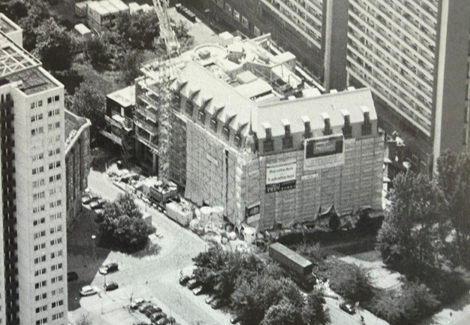
Several hurdles still had to be overcome before Wolfgang Loock ultimately took possession of the property. Following the initial award decision, restitution claims were submitted by the Abrahamsohn family and the Rewe retail group, which had acquired shares in Dugena.
The building ultimately passed to Mr Loock, and the Cologne architectural practice Plan², with Peter Becker, accompanied the project. The hotel opened in the summer of 1997 after more than two years of construction. Today, both parts of the building are owned by Convalor GmbH & Co.KG, which has maintained an operating agreement with Classik Hotel Collection GmbH for the Classik Hotel Alexander Plaza and the Classik Business Space for several decades.
FAQ
When Was the Classik Hotel Alexander Plaza Building Constructed?
The building at Rosenstraße 1 was completed around 1900 as a commercial complex. Fur trader Siegfried Abrahamsohn had previously acquired the property in 1898 and arranged for the smaller buildings on the site to be demolished.
How Was the Building Used Before It Became a Hotel?
The building initially accommodated a fur trading business and an electrical goods dealer. It was later used by the Alpina watchmaking cooperative, the company Dugena and a wholesale organisation in the GDR, among others.
When Did the Building Begin Operating as a Hotel?
Following a construction and renovation period of more than two years, the hotel opened in the summer of 1997. Since then, the Classik Hotel Alexander Plaza has combined historic architecture with modern hotel comfort.
Why Is Rosenstraße Historically Significant?
Rosenstraße is one of Berlin’s oldest streets and is located in the historic Marienviertel district. Its history stretches back several centuries and reflects Berlin’s development from a medieval city into a modern metropolis.
What Is the Significance of Heidereutergasse Beside the Hotel?
Berlin’s first synagogue was built on Heidereutergasse at the beginning of the 18th century and inaugurated in 1714. Today, the Alte Synagoge Berlin memorial commemorates the history of this important site of Jewish life.